The 2026 pro cycling season shifts into high gear this week with Tirreno-Adriatico (or The Race of Two Seas) a week-long jaunt across Italy. I was lucky enough to catch the live broadcast of Stage 2 which aired today and boy am I glad I got to see it!
A challenging ride, today’s race clocked in at 206 km from Camaiore to San Gimignano, a medieval Tuscan town famous for its hilltop towers and natural beauty. Throughout the day, riders faced narrow, rain-slicked roads, with the final climb winding up a treacherous stretch of gravel.
Three men fought for victory over the last few kilometers: perpetual favorite Mathieu Van Der Poel (Alpecin-Premier Tech), phenom Isaac Del Toro (UAE-Emirates), and up-and-comer Giulio Pellizzari (Red Bull-Bora-Hansgrohe). I was on the edge of my seat as the trio scrambled their way up to the finish.
Van Der Poel lost traction on his back wheel and almost crashed as he clipped out of one pedal and tried to regain control of his bike. Pellizzari, trying to avoid him, swerved dramatically and almost came to ruin. Del Toro stayed upright and just kept pedaling. In the final few meters, the three were neck-and-neck as their tires skidded over a section of limestone pavers just before the line.
Phew!
At the end of the day, Van Der Poel claimed victory, Del Toro was second, and Pellizzari third. Del Toro (one of the most exciting riders in the peloton, IMHO), ended the day in the blue jersey of the overall leader. I can’t wait to see what tomorrow brings!
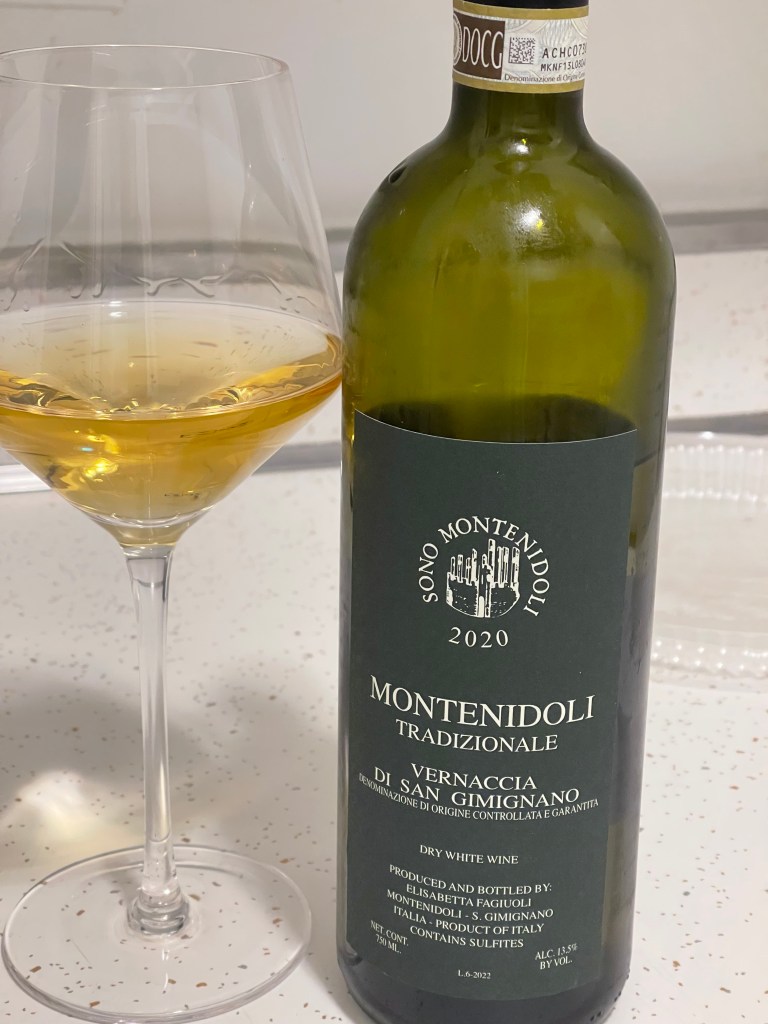
When in San Gimignano, Sip Wine from Montenidoli: Vernaccia Tradizionale
When Elisabetta Fagiuoli’s family arrived in San Gimignano 1965, the property had been abandoned: the woods had encroached on the fields, the olive trees were overgrown, and the vines were obscured by bushes. They literally started from the ground up, focusing on the health of the soil. They bred rabbits, using their manure as fertilizer. They introduced worms to the fields to make humus and soften the earth. Cuttings from winter pruning were ground and fermented to make a compost to go back to fertilize the plants. They “followed the rules of nature that are dictated by the weather, the days, the seasons.” Now, the 200 hectares of vines are certified organic by the ICEA.
Tasting Notes
Color: deep gold from extended skin contact
Nose: super-aromatic with notes of almond, freshly mown hay, apricot, citrus, and beeswax.
Palate: similarly complex with a rich, almost unctuous texture. Dried apricot, orange peel, almond. Moderately high acidity provides perfect balance to the richness. Damn, I love this wine!
 The Swirling Dervish