If you’ve been watching Stages 1-4, no doubt you’ve been on pins and needles, cringing at the crashes and ranting at the race directors for squeezing the peloton through tortuous roads studded with traffic furniture.
Well, I certainly have been!
Despite the drama, we head into Stage 5 with most of the favorites within striking distance of the yellow jersey. Pogaçar, Vingegaard, Evenepoel: Yep, all still in it. Rogliç? I’m willing to give him the benefit of a few more days before I write him off.
What has surprised me is Mathieu van der Poel’s stamina during the last few climbs of Stage 4. Perhaps the yellow jersey bestows magical powers on the legs? I look forward to the next few days, as I ponder how long he can hang with the GC contingent.
Another bright spot was watching Tadej fight for the stage win against MVP, with Jonas right on his heels. Such fun! Are we entering a new era of professional cycling? One in which the top riders are equally impressive across disciplines?
I’m here for all of it.
BTW: If you’d like to watch the highlights from Stage 3, here’s the link. The Tour no longer allows sharing from its YouTube channel. Boo on that! But it’s definitely worth checking out in any case.
What to Expect from Stage 5
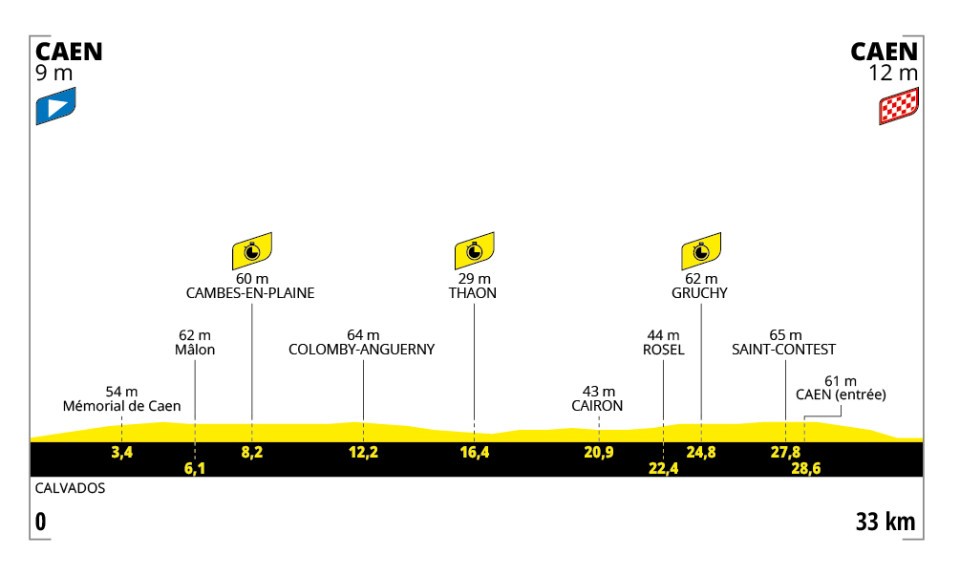
The time trial course is about 33 kilometers long, and flat as a pancake. My prediction is that Evenepoel will make up some time on his rivals, as I hope Rogliç will. Barring a disastrous performance by the other top GC guys, the overall standings should look pretty much the same at the end. But, hey, this is the Tour de France: anything can (and does) happen. I’ll be watching with bated breath, wishing safe passage to all. (No more hospital trips, fingers crossed.)
Tour de France by the Glass Recommendation – Calvados!
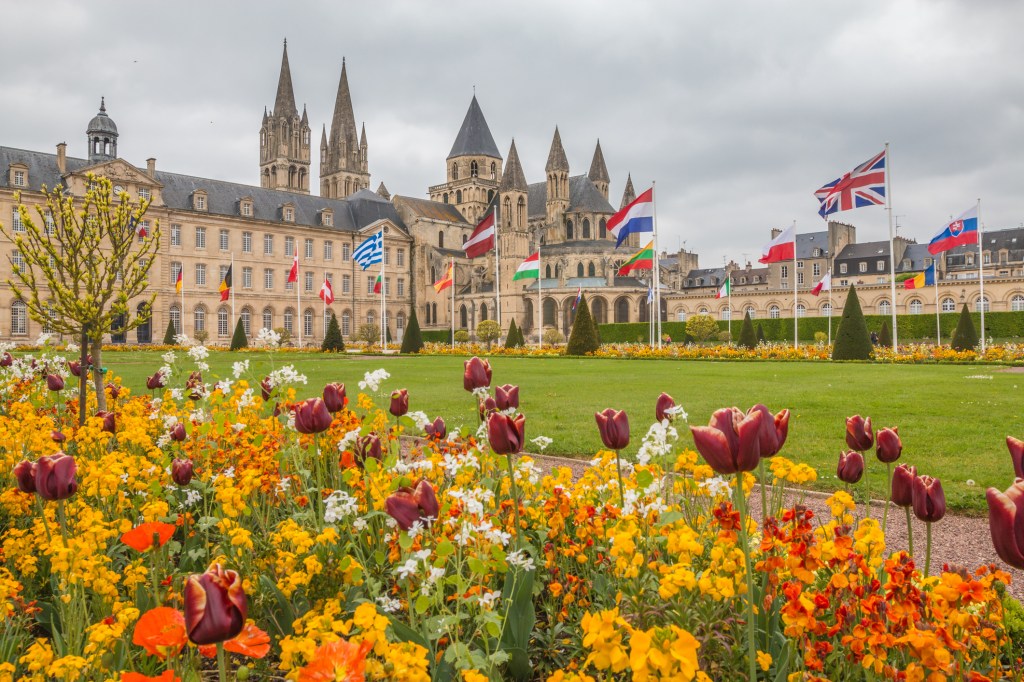
Today the riders race against the clock through the beautiful countryside of Normandy, home to artisanal spirits crafted from local apples and pears. Known locally as Calvados, it may be made in eleven sub-regions, with the best (IMHO) coming from the Vallée d’Auge, east of Caen (our host town for today’s stage). Calvados from this area is unique in that it must be distilled twice in copper pot stills and aged for at least two years. On a cold, rainy day, nothing warms the soul better than a snifter of delicious Calvados!

There are three AOCs governing Calvados production:
Calvados AOC
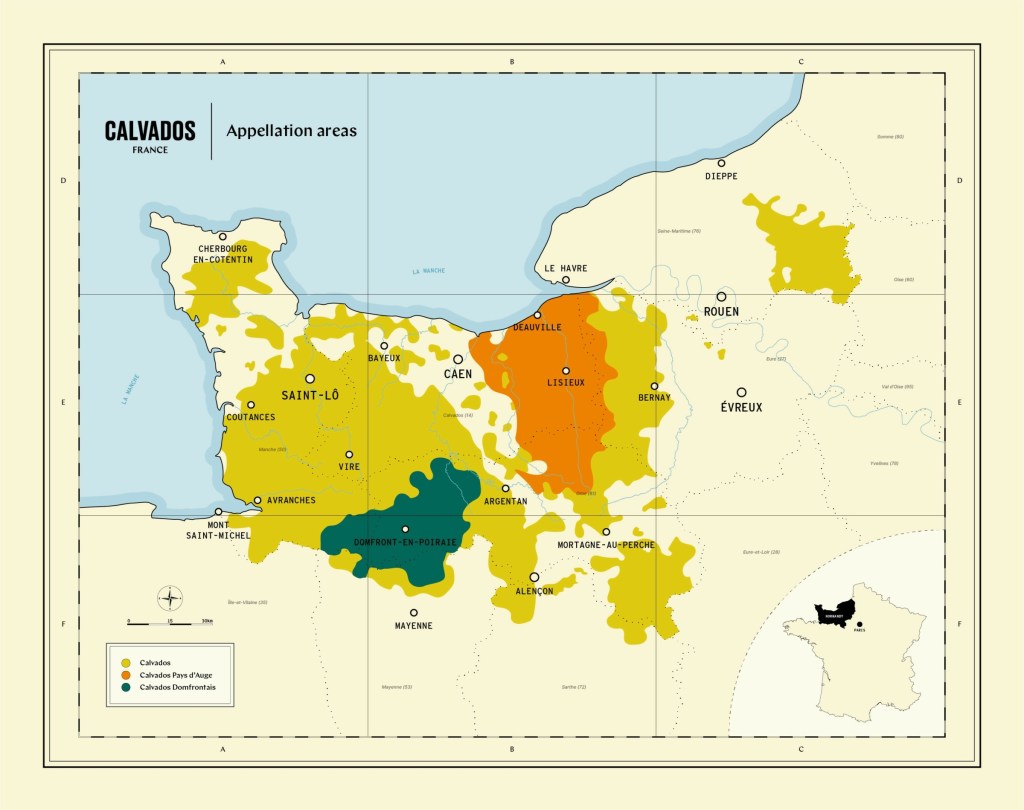
As you can see on the map, the Calvados appellation covers a large part of Lower Normandy and a fraction of the neighboring departments: Eure, Seine-Maritime, Mayenne, Sarthe and Oise. This area has an oceanic climate with abundant and regular rainfall.
Apples used in all Calvados production are classified as sweet, sharp, bittersweet, or bittersharp, and are usually blended according to the recipes of each distiller. They are further distinguished by whether they come from high- or low-stem orchards:
High stem orchards have a maximum density of 280 trees per hectare with a minimum spacing of 5 meters between trees. The maximum average yield of these orchards is 25 tons per hectare. High-stem fruit must comprise at least 35% of any Calvados blend. Low stem orchards have between 280 and 1,000 trees per hectare, with an average yield of 35 tons per hectare.
There is no mandatory method of distillation for Calvados AOC, but the use of column stills (aka continuous distillation) is most common.
Calvados Pays d’Auge AOC
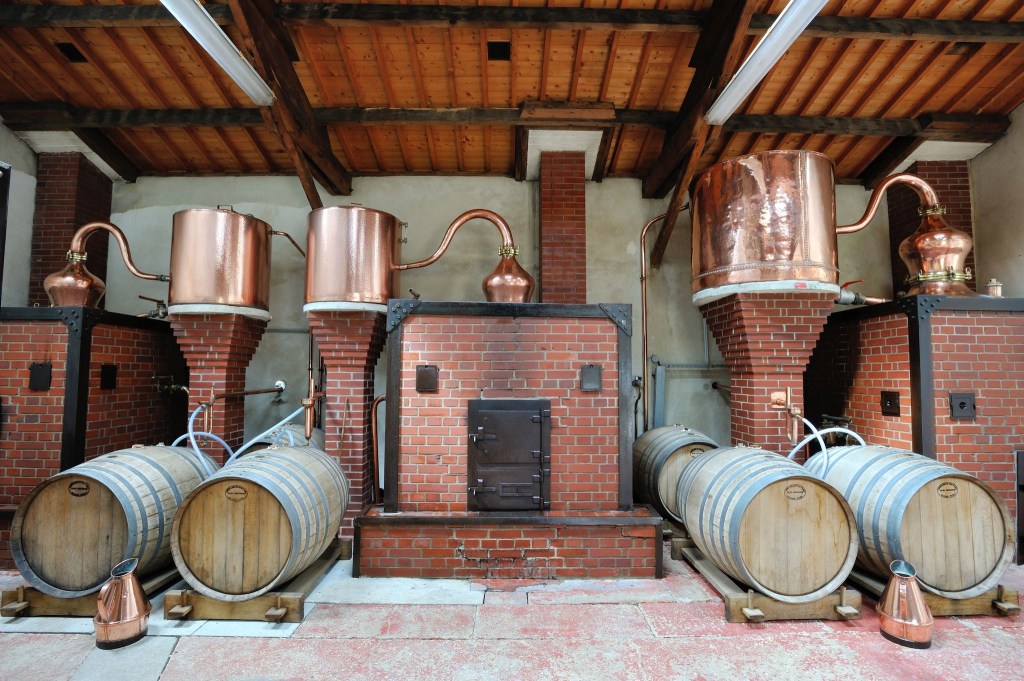
The Calvados Pays d’Auge appellation extends past the eastern limit of the Calvados region to include select communes in the Orne and Eure departments, where orchards lie on clay and limestone slopes. At least 45% of the fruit for Calvados Pays d’Auge must come from high-stem orchards and must include at least 30% perry pears (smaller and more bitter than regular pears.) The use of a pot still for double distillation is mandatory, and the Calvados must age for two years before release.
Calvados Domfrontais AOC
The Domfrontais region lies in southern Normandy and extends to selected communes in the Manche, Orne and Mayenne departments. What distinguishes this region from the others is the high proportion of perry pear trees grown in high-stem orchards, which must make up at least 80% of the planted area. The proportion of pear trees planted must be at least 25% of the total area of the orchards on the farm. Calvados Domfrontais is obtained by a simple continuous distillation using a column still, and ages at least three years in oak barrels before release.
Hungry Yet? Calvados in the Kitchen
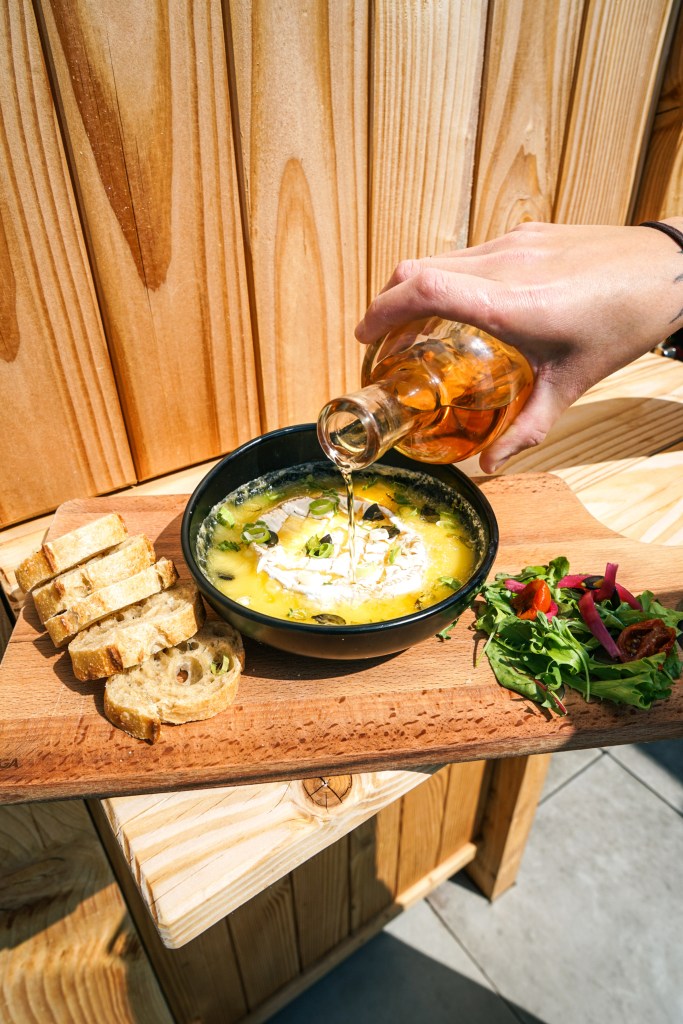
As one would expect, the handy chefs of Normandy make use of the region’s favorite spirit in their local dishes, too. How about a bite of Camembert Flambé with Calvados? Thanks to The People Caen, you can impress your guests, too!
For more detailed information on the Calvados region, its producers, and tourism, please stop by the Drink Calvados website. It’s a fantastic resource if you plan to visit!
See you again tomorrow for a recap of the ITT and a preview of Stage 5.
 The Swirling Dervish