An Iconic Stage Finish and Cru Beaujolais
For Stage 20’s tasting suggestion, I’m sending you due west of the peloton, out of the Alps and toward one of the most budget-friendly wine regions of France – Beaujolais. Yes, it is the same region responsible for case after case of uninteresting Beaujolais Nouveau, foisted on the world each November. But it is capable of so much more! This oblong parcel of land, sandwiched between Burgundy to the north and the Rhône to the south, specializes in the Gamay grape which, in the right hands and treated respectably, produces downright beautiful wines. And they can be real bargains, if you know how to shop for them.
There are several categories of Beaujolais. At the base level, which accounts for roughly half of all production, we have wines labeled simply as Beaujolais – no further distinction applies. The grapes are grown on the flatter expanses of the region and make agreeable, if not complex, wine. The next step up is what we call Beaujolais Villages, which makes use of grapes grown on the more desirable hillside locations, where they bask in full sunlight and enjoy the wind protection afforded by the hilly terrain. These advantages result in wines of more complexity and structure, with a background of beautiful ripe fruit. Most wine of this category is labeled simply as Beajolais Villages.
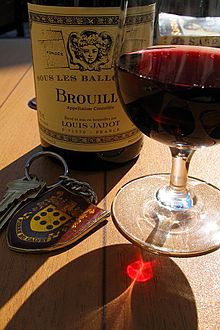
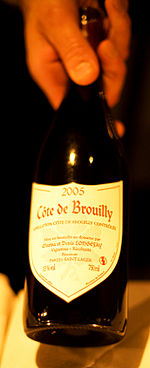
The individual villages that comprise the Beaujolais Villages appellation may, if they choose, post their names on the label. Ten of those villages, (all located in the northern reaches of Beaujolais) whose wines perpetually top the charts, are known as the Beaujolais Crus. They come from the best sites or terroirs, and have real personality. Quite a few of them are even capable of aging. Finding them is easy, once you understand how they’re labeled. Often, these bottles will show the name of the village only (see photos) without any reference to Beaujolais, so it can be a little confusing. But because they are so delicious (and budget-friendly) learning their names and basic characteristics will help you find them in your local wine store. Here’s a little cheat sheet:
St. Amour – on the lighter side, with a romantic name to boot
Brouilly – the largest of the Crus, with mass production; light and simple wines
Côte de Brouilly – higher elevations mean a bit more complexity than in Brouilly
Morgon – one of the biggest wines, in terms of structure and depth; holds its own
Régnié – light, soft and feminine; try one with a Morgon and compare
Chiroubles – charming village with wines to match
Fleurie – sounds like “flowers” and that’s not a bad description; delicate
Moulin-à-Vent – the masculine Beaujolais; some can age like a Burgundy
Chénas – smallest of the Crus in terms of land; not easy to find
Julienas – charming in youth, with the structure to go the distance
 Gamay makes a food-friendly partner and these wines, with their varying degrees of intensity, could keep company with anything from roasted chicken to a grilled rib-eye. Conduct a few experiments of your own and see which ones strike a note with you!
Stage 20: The Race Day We’ve Been Waiting For!
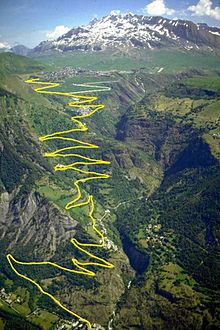
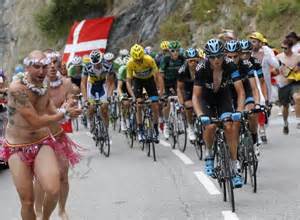
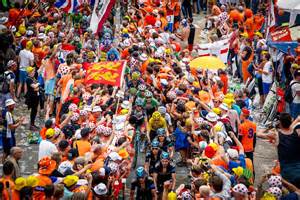
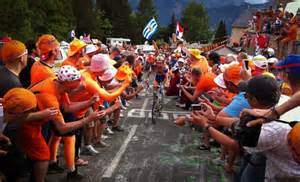 Get ready for some crazy today – and I don’t mean just the hairpin turns (see photo) and switch-backs that pepper the final climb of the stage. Traditionally the Alpe d’Huez plays host to some of cycling’s most raucous and creatively costumed fans. From middle-aged men clad in minuscule thongs (photo), to devils with pitchforks, the riders have plenty of “encouragement” as they haul themselves over this HC climb. Stay on the lookout for Dutch Corner, a blaze of orange-festooned RVs and campers and their similarly attired occupants, all paying homage to the nation that’s won more races on Alpe d’Huez than any other (see photos.)
By the time our riders have reached the summit, much will have been decided regarding the final placements of the 2015 Tour de France. Whoever dons the yellow jersey at the end of the penultimate day of the Tour (likely Chris Froome) will be recognized as the overall winner this year, and will enjoy a relaxed, ceremonial ride into Paris on Sunday, sipping Champagne and savoring his victory. For the climbers who aspire to the polka-dotted King of the Mountains jersey, Saturday is a crucial day as well. The last points in that competition will be awarded atop the Alpe d’Huez, where 50 points (rather than the usual 25) will be awarded to the man first across the line. With Chris Froome holding a tenuous lead over Romain Bardet and Joaquim Rodriguez, the Alpe d’Huez holds the key to the climbers’ jersey and a place in the record books.
 Alas, the sprinters will do their best to survive the vicious climbs and dream of Sunday and the Champs-Elysees, the grand boulevard of Paris that hosts the final stage of the Tour each year. While they have had moments of glory over the past three weeks, the last dash into the City of Light holds the most allure; it’s the most prestigious sprint stage in cycling, and all the big guys will be positioning themselves to have a go. But for Saturday, there is just one sprint stage up for grabs, about 94 km into the race.
Every mountain stage, I wait for Nairo Quintana to set a blistering pace that will leave the peloton gasping in his wake. Hasn’t happened yet, so perhaps today is his day! Froome remains in yellow, as he seems infallible after three grueling weeks. However it turns out, it should be an exciting day!
Vive le Tour!
 The Swirling Dervish